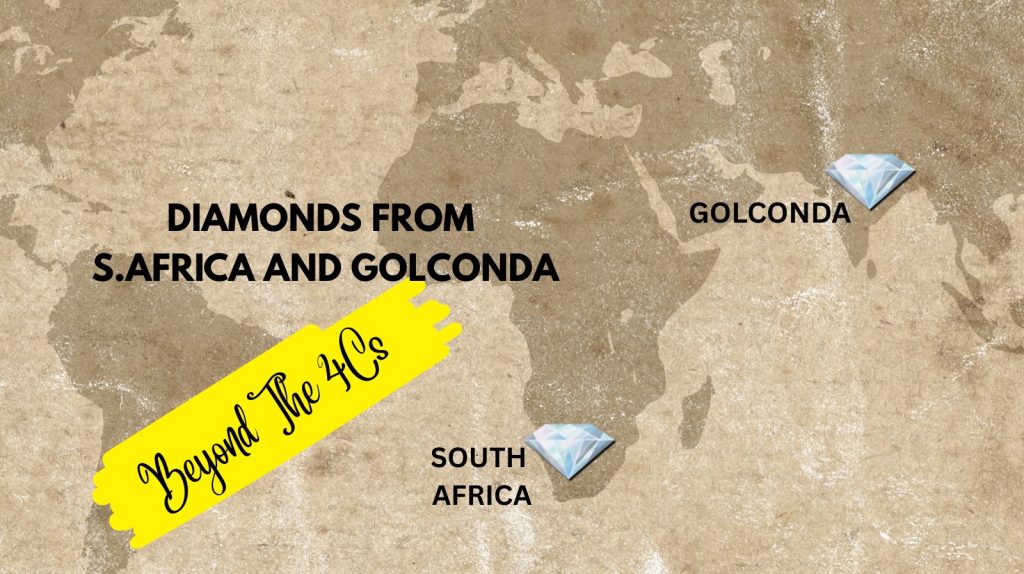
Diamonds have fascinated civilizations for centuries, but the story behind each diamond often holds as much importance as its measurable characteristics. While diamond value today is widely evaluated using the 4Cs — color, clarity, cut, and carat weight — the true distinction between diamonds from the legendary Golconda mines and those from South African mines goes far beyond this standardized grading system. These two mining regions represent two vastly different eras, geological histories, and cultural legacies.
MINING ERAS AND ORIGINS
The Golconda diamond mines, located in the ancient kingdom of Golconda in present-day Telangana and Andhra Pradesh, India, were active from approximately the 4th century BCE until the early 1700s. These mines were the world’s earliest known diamond sources and the exclusive supplier of diamonds for nearly 2,000 years. Mining in Golconda declined significantly after the early 18th century, and by the mid-1700s, most of the deposits were exhausted.
In contrast, South African diamond mining began much later. The discovery of diamonds near the Orange River in 1867 sparked the famous Kimberley diamond rush. Commercial mining grew rapidly from the late 1860s onward, and South Africa soon became one of the world’s top suppliers of diamonds. South African mines, particularly Kimberley, Premier (Cullinan), and Jagersfontein, are still active in various capacities even today.
Thus, while South African diamonds have a more recent geological and commercial provenance, Golconda diamonds belong to an ancient, historical, and often royal heritage.
GEOLOGICAL DIFFERENCES
Golconda diamonds are famed for their Type IIa classification — the purest form of diamond carbon, free from nitrogen impurities. These diamonds often display exceptional transparency, brilliance, and soft “limpid” water-like clarity. The finest Golconda diamonds appear almost glowing from within, a characteristic seldom replicated elsewhere. A small fraction of Golconda diamonds exhibit a blue color, this due to the presence of boron in the precious stone. Classified as Type IIb diamonds these blue Golconda diamonds are highly valued and sought after. Examples of blue diamonds from this region are the Hope Diamond, Seraphim Blue Diamond and the Golconda Blue Diamond.
South African diamonds, although many are of exceptional quality, tend to be Type IIa, containing trace nitrogen. The geological formation of South African stones is also much more recent than the ancient diamonds from India. As a result, their value is typically assessed more strictly by the 4Cs. A few examples of South African diamonds include the Cullinan group if diamonds (cut from a large piece of rough diamond), the Golden Jubilee diamond and the Taylor-Burton diamond.
HISTORICAL AND CULTURAL SIGNIFICANCE
What sets Golconda diamonds apart is their extraordinary journey through history. For centuries, the Golconda mines supplied diamonds to Mughal emperors, Persian royalty, Ottoman sultans, European monarchs, and wealthy traders. These diamonds often carry royal provenance, documented historical ownership, or appearances in royal treasuries. The Asaf Jahi Dynasty that ruled the Hyderabad region from 1724 to 1948, is well known for its dazzling collection of high value Golconda diamonds. Mentions are made of the Seraphim Blue Diamond and the Indigo Blue Diamond – which were once a part of the Nizams treasury.
South African diamonds, by contrast, entered the global market during the industrial age, a period of standardized mining, commercial cutting centers, and modern gem markets. Although few are now part of royal collections, their arrival into such treasuries is relatively recent. South African mines have yielded some spectacular diamonds, many of which have passed through the hands of royalty and international celebrities. The legendary Cullinan Diamond, discovered at the Premier Mine in 1905, remains the most iconic example; its largest cut stones, the Cullinan I and Cullinan II, are proudly set in the British Crown Jewels, symbolizing the enduring relationship between South Africa’s mineral wealth and royal tradition. Equally famous is the Taylor–Burton Diamond, a remarkable 69-carat pear-shaped gem once owned by Hollywood icons Richard Burton and Elizabeth Taylor, who showcased it at numerous high-profile events.
CONCLUSION
Golconda and South African diamonds each hold a distinct place in the world of gemology. South African diamonds represent modern commercial mining, scientific grading systems, and impressive geological size. Golconda diamonds, however, stand at the intersection of history, legend, and unmatched natural purity. Their rarity, provenance, and cultural importance ensure that they remain some of the most prized gems ever discovered.